

I have read a few books by Ernst Hemmingway, all of which I really enjoyed. I’ll admit Hemmingway’s books generally have mixed reviews as the person himself did, but I can’t deny his popularity strikes at the core of something people appreciate. What draws most people to Hemmingway is his style. It’s short, simple, and direct in a self-proclaimed way called the Iceberg Method. Let’s talk about what that is, and then I’ll show you how to use it for you brand.
First the method. His books are centered around facts and driven by dialog from the characters. He leaves a lot to be inferred by the audience and doesn’t tend to meander or describe every blade of grass. While he gives details, they are few but precise to give maximum impact. The books I’ve read feel like I’m walking into a larger conversation, that gets you interested as you start to put the pieces together.
Here’s how Hemmingway described it himself:
“If a writer of prose knows enough about what he is writing about he may omit things that he knows and the reader, if the writer is writing truly enough, will have a feeling of those things as strongly as though the writer had stated them. The dignity of movement of an iceberg is due to only one-eighth of it being above water.” – Death in the Afternoon, a meditation on the arts of bullfighting and writing, Hemmingway
What I love about Hemmingway’s writing is instead of detailing all aspects, he infers most of it. He trusts his audience to get a feel for what’s going on and doesn’t waste time. This approach directly applies to communicating with your customers, especially for social media ads that have a very short attention window.
Here are two ads for clothing that I think display this concept, one not great, and one good.
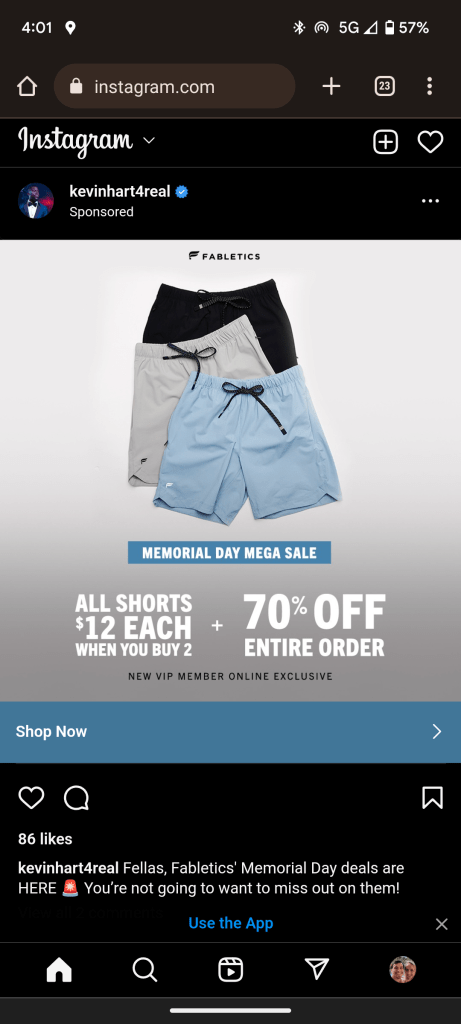
The first is for Fabletics, boosted from Kevin Hart’s Instagram account. There is a lot of information that needs to be simplified. It’s a new member-only offer, you must sign up for the VIP Online Exclusive, you must buy two pairs of shorts to get the $12 price. Personally, I think the 70% off your cart is enough.
A better message is “Memorial Day Mega Sale, Get 70% Off Everything”. Suppress your customers and use a prospecting audience. Invite potential customers in, and then let them find out about the 2-for $12 deal on shorts if you still want to run it.
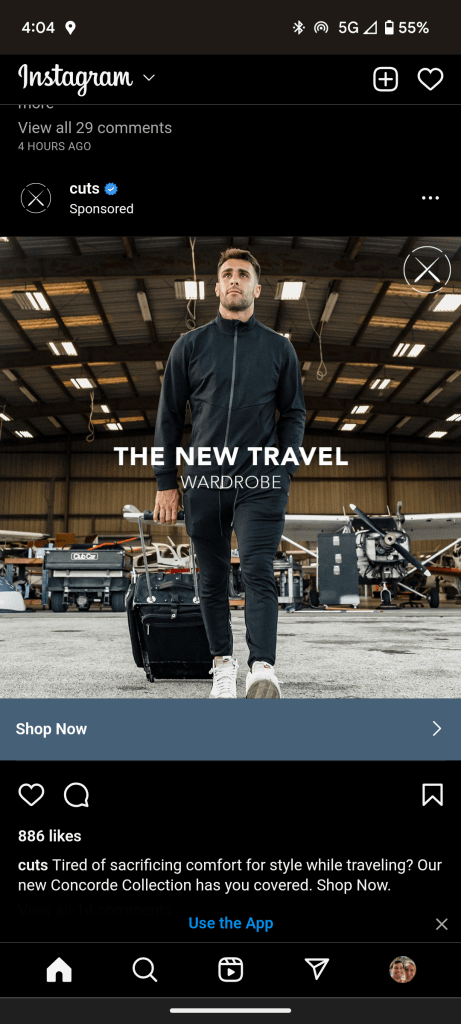
Here is a good example from Cuts. They use lifestyle imagery with a very simple message. “We make clothes for travel.” I know exactly what it looks like, exactly what they do, and if it’s enough to interest me I’ll click. They then continue the conversation on their site with 20% off giving me more motivation to purchase.
With these examples in mind here is a workflow on how to apply this to your ad development process.
- Identify your Audience
- You must know who it is you are talking to or trying to acquire. A lot of brands skip this step in favor of broadcasting a specific deal instead of considering who the audience is and what might motivate them.
- Identify
- Make a list of everything you would like to communicate to your prospect as if you were speaking to them plainly. Don’t consider the iceberg yet, go ahead and write everything down that can add value (why a person in your audience should buy your product). You can decide later what should be the tip of the iceberg.
- Strategize & Prioritize
- Review your list and start with strategy (when and how). When is the best time to communicate each item as well as what should be explicit (told) vs implicit (shown)? For example, if you’re a watchmaker and just released a new product. You want to inform your previous customers that you have a new watch for sale, and you also want to communicate that it’s very high-end. You would choose your channels, such as email and possibly social for an existing customer audience. Your primary message would be about the new watch and some key improvements you have made. You want to communicate it’s luxurious, but you don’t need to explicitly say that. You can leverage creative and copy in the content and landing page to implicitly inform your customer. Your ad would be the tip of the iceberg, your motivations would be everything subtly telling the prospect how nice it is from colors, to copy choice, to product and lifestyle images.
- Finally Simplify
- Pick one or two of the items you believe are most important and motivating for the tip of the iceberg. What do you have to tell your customer? You can then leverage other parts of the funnel to keep the conversation going like the PDP, or landing page. If one of those communication points isn’t working, you can always test and try a different one.
I always tell my client’s big brands like Nike and Apple almost never use home page carousels as their banners. While they have different content, they always have one prominent item a new phone, or shoe that they are telling you about. They have a consistent look and feel that communicates their brand to you implicitly. Thinking through your communication plan can create effective value propositions that will help you to grow your business.
 David Campanella's Blog
Leave a comment